Blog by Neil FrancisPosted on Thursday 14th September 2017 at 10:20pm
Another Catholic 'academic' spreads more misinformation. Photo: donaldytong
It’s very disappointing that Catholic theologian Dr Joel Hodge’s recent editorial in Fairfax media about assisted dying law reform contained misinformation: the same old tired and discredited story trotted out as though it's true. Dr Hodge also repeated an old and curiously one-sided (Catholic) examination of the hypothetical slippery slope.
Unhappily, the kind of misinformation that Dr Hodge advances muddies the waters and cruelly stands in the way of legislative action, which most Australians want.
An impeccable national survey conducted by scholars at Australian National University last year found 77% of Australians in favour of assisted dying law reform. Strong support (43%) outweighed strong opposition (4%) by more than ten to one. In the two states whose Parliaments are currently considering reform, NSW and Victoria, support stands at 75% and 79% respectively.
Non-religious support is 91%, and it’s high amongst Catholics (74%) and Anglicans (79%) as well. Bishops are jarringly out of step with the views of their flocks. And across the political spectrum, 87% of Greens, 80% of Labor, 77% of Coalition and 69% of minor party voters also want reform.
The electorate’s desires couldn’t be clearer. But politicians — who have little time to fact-check what they’re told — are fed the kind of misinformation Dr Hodge advances.
The false 'non-voluntary euthanasia slippery slope' argument
He quotes details from a medical journal article by Dr José Pereira, a Canadian Catholic physician. Like others who cite this article, Dr Hodge fails to mention that it was thoroughly debunked in a surgical deconstruction by expert scholars. They found Pereira’s claims variously unsupported by any evidence, unsupported by the sources he cited, or false, concluding that the article was “smoke and mirrors.”
Like other Catholics, Dr Hodge relies heavily on a thoroughly debunked journal article by Catholic Canadian doctor, José Pereira.A significant source of smoke, which Dr Hodge fans from this debunked article, is the claim regarding “900 Dutch deaths hastened without explicit request”: that is, non-voluntary euthanasia or NVE. Such figures are cited as ‘proof’ of the hypothetical slippery slope from legalised voluntary euthanasia to NVE.
Other opponents of assisted dying variously put the figure at 500 or 1,000. For the sake of argument, let’s say the 900 figure is equivalent to 1,000. Both the 500 and 1,000 figures, also repeatedly promoted by Catholic ethicist Professor Margaret Somerville and others, have been true. But here’s the thing.
What they don’t mention is that the 1,000 rate is from the 1990s when Dutch assisted dying was conducted under a general regulatory framework. In 2002 the Dutch euthanasia Act came into effect. Amongst the Act's many details was the establishment of a Commission which examines every reported case of assistance.
Since then, the Dutch NVE rate has dropped to 500, and even further. It has stayed low and is now similar to the NVE rate in the United Kingdom, the world’s gold standard for palliative care, and where assisted dying remains illegal.
There was a significant drop in the NVE rate in Belgium, too, after its euthanasia Act came into effect, also in 2002.
It is absolutely unconscionable that yet another Catholic commentator has trotted out the same old lie as though it's true. Dr Hodge is an academic and it is incumbent on him to check the facts before sounding off.By cherry-picking a single figure, opponents argue the opposite of the facts, implying or even directly claiming that NVE rates are caused by or have risen as a result of legalised assisted dying. I’ve comprehensively exposed this nonsense before, yet it comes up repeatedly.
It’s similar to other lines of Catholic argument against assisted dying, like the claim that Dutch elderly supposedly travel to Germany for healthcare because they fear being euthanised by their Dutch doctors — an outrageous falsehood. There’s also the faintly desperate claim that Dr Els Borst, the architect of the Dutch euthanasia Act, later regretted her reform — a fake claim she’s firmly corrected.
Consider too a Catholic bishop’s claim, without reservation and in formal evidence before an official Parliamentary inquiry, that Oregon’s general suicide rate was very low prior to its assisted dying Act but very high afterwards — contrary to the facts. Or a report cherry-picking just half a sentence from a journal paper to claim that a significant proportion of assisted-death patients in Oregon had symptoms of depression, when the other half of the verysame sentence clearly stated that none of them had.
As Professors Griffiths, Weyers and Adams wrote in 2008, “imprecision, exaggeration, suggestion and innuendo, misinterpretation and misrepresentation [and worse] took the place of careful analysis.” Sadly, the same still seems true today.
Major Catholic flip-flop on choosing death
Now let’s turn our attention to the core of Dr Hodge’s thesis. His plea for “the vulnerable” leads his argument and is heavily egged throughout the polemical pudding.
A comparison is moot: Australians have the right to refuse any unwanted medical treatment, even if it’s life-saving.
In my home state of Victoria, this right to refuse is enshrined in statute. The statute contains just three ‘safeguards’ for checking a refusal, and those only apply if the refusal is formally documented in writing but not if it’s only oral.
As I’ve explained in detail before, the consequence is that a person can refuse life-saving medical treatment with few if any checks and balances. In theory, just as Dr Hodge argues in regard to assisted dying, the person might feel pressured by greedy relatives, resource-poor doctors or others, to so refuse.
In this case, where is the Catholic call for protections? Where is the moral outrage on behalf of ‘vulnerable patients’? There is none. In fact, the Catholic Church’s call is quite the opposite. In a directive to all Catholic healthcare institutions in the USA, the Conference of Catholic Bishops make the Church’s position abundantly clear. They direct that there is no obligation for patients to use “disproportionate means of preserving life.”
The Catholic church's rhetoric against assisted dying is a major flip-flop when compared to its cosy attitude towards refusal of life-saving medical treatment: both might result in hypothetical pressure to choose death, yet only assisted dying has adequate safeguards.They define disproportionate means as “…those that in the patient’s judgement do not offer a reasonable hope of benefit or entail an excessive burden, or impose excessive expense on the family or the community.”
So, under two identical hypothetical possibilities of inappropriate persuasion to choose death, Dr Hodge’s argument bristles against an assisted dying reform containing — as he acknowledges — no fewer than 68 safeguards, while his Church argues that patients may refuse life-saving medical treatment if the patient feels it’s “hopeless,” entails “excessive burden” or imposes “excessive expense” on others, with hardly any, or no statutory safeguards at all.
The incoherence, and repetition of misinformation, is indefensible. Civil debate on such an important matter deserves better.
Blog by Neil FrancisPosted on Sunday 6th August 2017 at 2:31am
The terminally ill are not choosing between life and death, but between two ways of dying, according to their own beliefs and conscience. Photo: Andrew Drummond/AAP
In Monday’s Herald Sun, Victorian Archbishops Philip Freier and Denis Hart, and Bishops Ezekiel, Suriel, Lester Briebbenow, Bosco Puthur and Peter Stasiuk published a half-page advertisement admonishing the Victorian government for its initiative to legalise assisted dying for the terminally ill, an ad similar to the one published by religious figures in 2008.
I have no quarrel with individuals of faith regarding their own private beliefs. However, the bishops’ attempt at public “leadership” through the advertisement is deserving of redress for its multiple fallacies.
The ‘abandonment’ fallacy
The bishops claimed that assisted dying “represents the abandonment of those who are in greatest need of our care and support”. On the contrary: to ignore the deeply-held beliefs and rigorously-tested wishes of people at the end of life is to abandon their values and critical faculties in favour of the bishops’ own religious dogma.
The ‘competition’ fallacy
The bishops demand there should be more funding for healthcare rather than assisted dying, fallaciously pitting one option against the other. The Victorian government is indeed increasing funding for palliative care. It’s also aiming to provide lawful assisted dying for when even the best palliative care can’t help – which Palliative Care Australia has acknowledged – giving lie to the faux competition.
The evidential fallacy
Contrary to the bishops’ false presumption that legalised assisted dying will decrease trust in “the treatment and quality of care” from doctors, scientific studies into attitude change show that more people trust doctors when assisted dying is legal. Patients can then talk openly about options, even if they decide against assisted death. The bishops have abandoned facts in favour of religious assumptions.
The equivalence fallacy
The bishops refer to assisted dying as “government endorsed suicide”. They fallaciously equate a reasoned, tested and accompanied decision for a peaceful assisted death in the face of a terminal illness, with the impulsive, violent, isolated and regrettable suicide of individuals (many of whom have mental health and substance abuse issues) who are failing to cope with problems that can be addressed.
However, while the latter are choosing between life and death, the terminally ill are choosing not between life and death, but between two different ways of dying, according to their own beliefs and conscience. Rigorous 2016 research from Australian National University shows that the vast majority (79%) of Victorians support assisted dying choice for the terminally ill (with just 8% opposed), clearly distinguishing it from general suicide.
Shame on the bishops for disrespectfully equating the two.
The inconsistency fallacy
They also argue that assisted dying ought to remain prohibited because within healthcare, “mistakes happen and the vulnerable are exploited,” and “that in spite of our best efforts, our justice system could never guarantee” no one would die by mistake or false evidence. However, as I’ve pointed out before, an identical hypothetical problem exists under the refusal of life-saving medical treatment, a statutory right that Victorians have enjoyed for nearly 30 years. The statute has only three “safeguard” requirements, yet even those only apply if the refusal is formally documented, but not if it’s verbal.
Further, the United States Conference of Catholic Bishops directs that patients may refuse treatment if it imposes “excessive expense on the family or community,” yet makes no mention of the hypothetical “vulnerability” of the patient to be persuaded so, nor directs any requirements to assess the veracity of the refusal.
In stark contrast, the Victorian proposal for assisted dying legislation contains more than 60 safeguards and oversights.
The bishops are at risk of ridicule for such a gargantuan flip-flop: supporting the refusal of life-saving treatment with little or no oversight, while vocally opposing assisted dying legislation that mandates an armada of protections.
The not-so-hidden agenda
The bishops’ methods are rather unsubtle – hoping that these arguments, erroneous but carefully crafted to avoid any religious connotations, will be accepted as non-religious. Yet religion is writ large across their plea: as signatories to the letter they are all clerics employed directly and centrally in the promotion of their religions.
The authority fallacy
They might also rely on their religious status to convey gravity and authority to their pleas. Yet as people paid to do a job, like anyone else, their titles grant them no special privileges in lecturing Victorians about how they should die in the face of a terminal illness.
According to the 2016 census, just 23% of Victorians identified as Catholic, 9% as Anglican, 0.5% as Lutheran, and the other bishops’ signatory denominations so small as to not appear separately in the government’s statistics. Combined, the bishops’ faiths represent around 33% of the Victorian population, while 32% of Victorians identify with no faith at all. Surely the bishops are not arguing that they’re speaking for these other Victorians, too?
But the bishops don’t represent the views of their own flocks, either. According to the 2016 ANU study, 89% of non-religious Victorians support assisted dying law reform, as do 78% of Victorian Catholics and Anglicans. Indeed, opposition to assisted dying exists mostly among those who attend religious services once a week or more often – that is, those who are frequently exposed institutional religious messages of opposition – yet who comprise just 12% of Australians and 11% of Victorians.
Minding their own flocks
Australians are abandoning religion in droves. For example, when Freier ascended to the top job of Anglican Primate of Australia in 2006, some 19% of Australians identified as Anglican (2006 census). A decade later under his leadership, the 2016 census showed a drop of about a third to just 13%, and in Victoria, his home territory, to just 9%.
Hart’s Catholic church has experienced a drop in affiliation too, and it’s likely to continue and accelerate as Australians react with shock and disgust to the extent of child sexual abuse that the royal commission has exposed from under his organisation’s “pastoral umbrella”.
In conclusion, rather than bishops lecturing the government and Victorians with fallacious and faintly desperate arguments about the choices they shouldn’t have at the end of life, attending to their own flocks may be more useful Christian leadership.
May their God go with them in that endeavour.
This article was originally published in The Guardian.
Blog by Neil FrancisPosted on Thursday 27th July 2017 at 11:52pm
Research results must be judged in relation to the study's methodology.
In his latest blog, titled “Who are you going to trust?”, anti-assisted dying lobbyist Mr Paul Russell says:
“Polling noted today in the Australian shows a significant level of distrust in our political classes to get the issue of euthanasia and assisted dying right.”
He then goes on to quote some select statistics from said poll. In his blog, he mentions nothing about the sponsorship or conduct of the poll. After some searching, I found no other reference to said poll on his ‘HOPE’ website.
This is rather curious, because The Australian article he quotes, points out that the ‘poll’ was commissioned by him (his website is called ‘HOPE’).
Thus, Mr Russell tries to add credibility to his ‘poll results’ in his blog by citing only that it has been reported in a national newspaper. This ‘quote-someone-else-so-it-must-be-authoritative’ rhetorical strategy has been used before by opponents of assisted dying (see Box at end).
But as Mr Russell has himself promoted — happily republishing the opinion of the CEO of Christian Medical Fellowship (UK) — “opinion polls add up to very little.” That’s quite true… when they’re poorly designed and run, including the big no-no, ‘push-polling’, in which the researcher attempts to get the answer they want by crafting questions more likely to get it.
I searched hard for any reference to the methodology of said ‘poll’, but was unable to identify any despite a diligent search. Therefore, we don’t know what approach Mr Russell took: robust or otherwise.
Let’s assume for the sake of argument (and the absence of public evidence) that a poll of some kind was actually conducted. If it were a truly legitimate poll, you’d think that Mr Russell would be shouting about the study from his own rooftop (the ‘HOPE’ website). But so far, he hasn’t.
Mr Russell, while quoting statistics, has said absolutely nothing about the methodology — that I can find via a quite diligent search.
Results can only be interpreted in light of how the research was actually conducted, so quoting a 'study' while failing to publish its methodology in full is an absolute no-no. It only invites derision.
Rebecca Urban, for The Australian, quotes a number of ‘statistics’ from the ‘poll’ seemingly without question. But she’s hardly to blame: she’s skilled at journalism, not primary research.
So, for the benefit of Paul Russell, Rebecca Urban and all journalists reporting claimed statistics, here’s your minimum standard of conduct if the public are not to guffaw at the claims. All reported results must be in relation to properly disclosed methodology:
Who commissioned the research? (✔ Ms Urban reports who)
Who conducted — actually carried out — the research (e.g. a reputable research company)?
What precise population were respondents drawn from, how were they recruited, and screened in or out? What were the counts and percentage participation (approached/participated)?
What were the dates of the fieldwork?
What procedures were used to establish and maintain the authenticity of who was sampled (e.g. if an online poll, could people from anywhere technically participate in this Victorian poll)?
How was the questionnaire administered (e.g. paper self-complete, online, CATI)?
What was the script of stimuli administered to respondents? In other words, what prompts were given and what questions were asked: exact order and wording?
What results were obtained for each question (i.e. full rather than selective crosstabs)?
Until Mr Russell publishes in full how his ‘poll’ was conducted, the only honourable course of action for him to pursue is to withdraw the claimed results.
Until then, we can only see them as untrustworthy and a bit of a joke.
Rhetorical tactic — “Not” quoting yourself
This rhetorical tactic is also used by Mr Russell’s fellow Catholic, Prof. Margaret Somerville. For example, in her 2015 book Bird on an Ethics Wire, in relation to the supposed (but fanciful) fear of being euthanized in the Netherlands if adequate pain management is accepted, Somerville says in Chapter 4:
“It has been alleged that Dutch physicians have interpreted patients’ consent to pain management as consent to euthanasia.38”
If you’re like most people, you’d assume, given the effort of a citation (38), that an independent source had made the statement based on some evidence. Indeed, if you look at reference 38 you’ll see that the author is Lauren Vogel, and the source article is in the Canadian Medical Association Journal. All sounds like solid, legit stuff, doesn’t it?
However, Ms Vogel is a journalist, not a Dutch medic or a researcher, and what she reports in relation to Somerville’s claim is merely a quote of what someone said. And who is that someone? Why, it’s Margaret Somerville — what a coincidence!
Somerville could have just said “I’ve argued this before…”, but instead gives a seemingly robust reference to a source that has the appearance of independence and scholarship. Yet obviously she knows that the source is merely herself saying so.
Let’s be clear: something is not true just because someone alleges it. Even if they allege it twice or more. And happen cite themselves via someone else in the process.
Blog by Neil FrancisPosted on Friday 21st July 2017 at 1:53am
The Parliament of Victoria, Australia
The Victorian Government has introduced its assisted dying Bill into the Victorian Parliament. It's based on extensive consultation with a wide range of stakeholders, and over 1,000 submissions. You can read all about it here.
The Ministerial Advisory Panel on voluntary assisted dying today handed down its final report to the Government.
The Panel was comprised of seven subject experts, with Professor Brian Owler as Chair and Professor Margaret O'Connor as Deputy Chair.
It consulted extensively across Victoria, taking hundreds of submissions and appearances from relevant stakeholders, and reviewing legislation from other jurisdictions in which one form or other of assisted dying is permitted.
Today, it formally handed its report, comprising over 250 pages, to the Government.
The Panel has developed what is arguably the world's most detailed and carefully laid out principles to inform legislation, and are a credit to its efforts and professionalism.
Key aspects of the recommendations for voluntary assisted dying are:
The person must be 18 years or over; and
Be ordinarily resident in Victoria and an Australian citizen or permanent resident; and
Have decision-making capacity in relation to voluntary assisted dying; and
Be diagnosed with an incurable disease, illness or medical condition that:
is advanced, progressive and will cause death; and
is expected to cause death within 12 months; and
is causing suffering that cannot be relieved in a manner the person deems tolerable; and
Doctors and other healthcare workers are not permitted to raise assisted dying — only to respond to formal patient requests.
The person must make three formal requests, the second of which must be written and witnessed by two independent people.
The person must make the request themselves. Nobody else is authorised to make the request, and the request cannot be made via an advance care directive.
Ordinarily, the minimum timeframe between first request and opportunity to take the medication is ten days.
The person must maintain decisional capacity at all three requests.
Two doctors must reach independent assessments that the person qualifies.
Only doctors who have completed specialist training for voluntary assisted dying may participate.
Any healthcare worker may decline to participate for any reason, without penalty.
A prescription dispensed for the purpose of voluntary assisted dying must be kept in a locked box and any unused portion returned to the pharmacy after death.
The person must self-administer the medication; except if the person is unable to, a doctor may administer. An independent witness is required if the doctor administers.
Establishment of an authority to receive assisted dying reports, to assess reports, and to refer unacceptable cases to disciplinary or prosecutorial authorities.
For Parliament to review summary reports; twice in the first two years and annually thereafter; a formal review at five years.
In total, the recommendations include no fewer than 68 safeguards, designed to strike, uniquely for Victoria, an appropriate balance between access to the law, and protection of dying persons.
The Government will respond to the Final Report shortly, and it is anticipated that legislation will be introduced into the Victorian Parliament in August or early September.
A full copy of the Final Report can be obtained here.
-----
Safeguards proposed for Victoria's voluntary assisted dying framework
Access
Voluntary
Limited to 18 years and over
Residency requirement [Victorian resident and Australian citizen or permanent resident]
Limited to those with decision-making capacity
Must be diagnosed with condition that meets restrictive set of criteria [advanced, progressive and will cause death]
End of life is clearly defined [death expected within weeks or months, not more than 12 months]
End of life condition combined with requirement for suffering
All of the eligibility criteria must be met
Mental illness alone does not satisfy the eligibility criteria
Disability alone does not satisfy the eligibility criteria
Request
Must be initiated by the person themselves
No substitute decision makers allowed
Cannot be included as part of an advance directive
Health practitioner prohibited from raising voluntary assisted dying
Person must make three separate requests
Must have written request [witnessed in the presence of a medical practitioner]
Two independent witnesses to request [exclusions for family members, beneficiaries, paid providers]
Specified time must elapse between requests [first and third requests must be at least 10 days apart with exception when death imminent]
Additional time required to elapse between steps of completing process [second assessment and third request must be at least one day apart
Must use independent accredited interpreter [if an interpreter is required]
No obligation to proceed, may withdraw at any time
Assessment
Eligibility and voluntariness assessed by medical practitioners
Must be two separate and independent assessments by medical practitioners
Assessing medical practitioners must have high level of training/experience
Assessing medical practitioners must have undertaken prescribed training [to identify capacity and abuse issues]
Requirement to properly inform person of diagnosis, prognosis and treatment options, palliative care, etc, [by both assessing medical practitioners]
Referral for further independent assessment if there is doubt about decision-making capacity
Coordinating medical practitioner must confirm in writing that they are satisfied that all of the requirements have been met
Medication management
Person required to appoint contact person who will return medication if unused
Medical practitioner must obtain a permit to prescribe the medication to the person
Medication must be labelled for use, safe handling, storage and disposal
Pharmacist also required to inform the person about administration and obligations
Medication must be stored in a locked box
Administration
Medication must be self-administered [except in exceptional circumstances]
If physical incapacity, medical practitioner may administer
Additional certification required if administered by medical practitioner
Witness present if medical practitioner administers
Practitioner protections
Health practitioner may conscientiously object to participating
Explicit protection for health practitioners who are present at time of person self-administering
Explicit protection for health practitioners acting in good faith without negligence within the legislation
Mandatory notification by any health practitioner if another health practitioner acting outside legislation
Voluntary notification by a member of the public of a health practitioner acting outside legislation
Mandatory reporting
Reporting forms set out in legislation
Reporting mandated at a range of points and from a range of participants to support accuracy
First assessment reported [to Board]
Second assessment reported [to Board]
Final certification for authorisation reported [to Board, incorporates written declaration and contact person nomination]
Additional form reported [to Board] if medication administered by medical practitioner
Prescription authorisation reported by DHHS [to Board]
Dispensing of medication reported [to Board]
Return of unused medication to pharmacist reported [to Board]
Death notification data reported [to BDM and collected by Board]
Offences
New offence to induce a person, through dishonesty or undue influence, to request voluntary assisted dying
New offence to induce a person, through dishonesty or undue influence, to self-administer the lethal dose of medication
New offence to falsify records related to voluntary assisted dying
New offence of failing to report on voluntary assisted dying
Existing criminal offences for the crimes of murder and aiding and abetting suicide continue to apply to those who act outside the legislation
Oversight
Guiding principles included in legislation
Board is an independent statutory body
Board functions described in legislation
Board reviews compliance
Board reviews all cases of [and each attempt to access] voluntary assisted dying
Board has referral powers for breaches
Board also has quality assurance and improvement functions
Board has expanded multidisciplinary membership
Board reports to publicly [to Parliament every six months for first two years, thereafter annually
Five year review of the legislation
Guidelines to be developed for supporting implementation
Blog by Neil FrancisPosted on Wednesday 21st June 2017 at 3:14am
More Dutch evidence contradicts Margaret Somerville's 'suicide contagion' theory
I’ve previously published an extensive analysis of how Professor Margaret Somerville, of the Catholic Notre Dame University of Australia, cherry-picked her way through select data that seemed to be (but wasn’t) consistent with her ‘contagion’ theory from assisted dying to the general suicide rate. I provided ample evidence from lawful jurisdictions that comprehensively contradicts her claim. I also published the summary in ABC Religion & Ethics.
Yet Somerville still says despite extensive real-world experience to the contrary, that “I believe that my [suicide contagion] statement will prove to be correct.”
She and her Catholic colleagues still hold onto several tenuous threads of information that might — just might — appear consistent with her theory, despite the truckloads of evidence to the contrary.
One of those tenuous threads is that the general suicide rate in the Netherlands has increased from 2008, around the same time that use of the Dutch euthanasia law also increased. (The general suicide rate previously fell as assisted dying rates increased.)
I reported official Dutch government statistics and expert financial reports to show that the unemployment rate explains most (80%) of the variation in the Dutch general suicide rate since 1960, and that the Netherlands was particularly hard-hit by the global financial crisis from 2008 — whereas neighbouring Belgium wasn’t and its suicide rate dropped as assisted dying numbers increased. Unemployment in hard times is a known significant risk factor for suicide.
Now, a detailed and peer-reviewed analysis of Dutch data recently published in the Netherlands Journal of Medicine throws more mud in the face of Somerville’s theory.1
The research looked at the Dutch assisted death and general suicide rates from 2002 through 2014, separately for each of the five Euthanasia Commission reporting regions.
Headline results of the averages for 2002–14 are shown in Figure 1.
Figure 1: The average assisted death rate (and suicide rate) as a percent of all deaths by region, 2002-14 Source: Koopman & Putter 2016
As you can see, Region 3, which includes Amsterdam, had by far the greatest assisted death rate (3.4%), compared with the other four regions (1.7% – 2.0%). Yet Region 3’s suicide rate at 1.2% was the same as Region 5 which had only half the assisted death rate of Region 3 (1.7% vs 3.4%). (The authors, unusually, expressed suicides as a percentage of all deaths rather than per 100k population.)
The results are the opposite of Somerville’s theory which says that Region 3’s general suicide rate should be much higher than (not the same as) Region 5’s.
Those figures are the average for 2002–14. It’s possible that the picture is a little different for the more recent years in which the assisted dying rate is higher.
To answer that question, I’ve retrieved official Dutch Government data and calculated the assisted dying rates and general suicide rates for 2014 alone, the most recent year for which all the data is available. I’ve also calculated the general suicide rate per 100,000 population, the more usual way of reporting and comparing suicide statistics. The results are shown in Figure 2.
Figure 2: The Dutch assisted death rate and general suicide rate by region for 2014 Sources: Euthanasia Commission annual reports, Dutch Government statistics
While region 1 (the far north) has the lowest assisted death rate (3.2% of all deaths), it has by far the highest general suicide rate (13.6 per 100k population).
The latest Dutch regional data shows the opposite of Margaret Somerville’s ‘suicide contagion’ theory, adding to the already extensive evidence against it.Conversely, region 3 (which includes Amsterdam) has by a very large factor the highest assisted dying rate (6.0% of all deaths), yet it has the second-lowest general suicide rate (10.3 per 100k population).
This latest empirical evidence is consistent with other extensive evidence I’ve published showing an inverse — or no — relationship between assisted dying rates and general suicide rates.
The question is whether Margaret Somerville and her Catholic friends will pay the slightest attention, or continue to rely on invalid, cherry-picked morsels of data that they think support their theory, but don’t.
References
Koopman, JJE & Putter, H 2016, 'Regional variation in the practice of euthanasia and physician-assisted suicide in the Netherlands', Netherlands Journal of Medicine, 74(9), pp. 387-394.
Blog by Neil FrancisPosted on Tuesday 20th June 2017 at 9:23pm
Yet more research contradicts Prof. Margaret Somerville's Dutch NVE claim
I’ve criticised Catholic ethicist Professor Margaret Somerville in the past for promoting misinformation about assisted dying. One of her favourite stories is about supposed non-voluntary euthanasia (NVE) ‘contagion’ from voluntary euthanasia laws.
NVE is where a doctor deliberately hastens the death of a patient without a current explicit request from the patient.
Somerville claims that elderly Dutch citizens fear NVE — a slippery slope claim previously promoted by the Vatican. She stated that:
“Old Dutch citizens are seeking admission to nursing homes and hospitals in Germany, which has a strict prohibition against euthanasia because of its Nazi past, and they're too frightened to go into nursing homes or hospitals in the Netherlands.”
She made the claim with certainty and without qualification.
She also stated it under the credentials of Professor, yet has offered not a shred of sound, verifiable evidence. That's unscholarly.
Her claim is premised on two false beliefs, that:
The Dutch assisted dying law causes NVE —extrapolated to mean that elderly Dutch are therefore fearful of NVE in the Netherlands; and
Because assisted dying is illegal in Germany, NVE doesn’t happen there — extrapolated to mean that elderly Dutch are confident in German healthcare and seek it in preference to their own.
Belief 1 is soundly contradicted by the evidence. Researchers have found small but significant rates of NVE in every country they’ve studied (though that to date hasn’t included Germany). They’ve also found that the rates of NVE in the Netherlands and Belgium have dropped (not risen) significantly since their assisted dying laws came into effect in 2002.
Now, new research comprehensively knocks Belief 2 off its perch, too.
In a pilot study just published in the German Medical Weekly, a team led by Professor Karl Beine of Witten/Herdecke University in Germany found that around 3.1% of doctors and nurses surveyed were aware of deliberately hastened deaths (which is illegal in Germany) in the past twelve months, and that 2.4% of them administered it themselves.
A new study has found that of German nurses and doctors who had intentionally administered life-ending drugs to patients (which is against the law), 40% of them had not been asked to do so by the patient: non-voluntary euthanasia. Further, of those who administered it themselves, 40% hadn’t been asked for it by the patient. That's NVE.
While previous evidence strongly suggested that NVE would occur in Germany as everywhere else, this study now factually establishes that it does.
The study authors concluded that “illegal intentional life-ending acts were administered by physicians and nurses in all healthcare areas [hospitals and nursing homes] under investigation.”
So much for Somerville’s second premise.
Now both premises of her misinformed NVE story are soundly contradicted by empirical research evidence.
Update: Margaret Somerville is now Professor of Ethics at the Catholic University of Notre Dame Australia.
In the previous video a claim by Catholic Professor of Ethics Margaret Somerville was rebutted: that the Dutch and Belgians seek health care in Germany because they fear being killed by their own doctors and without being asked. In this video, she furthers her bizarre claim by referring to Dutch and Belgian non-voluntary euthanasia rates as 'proof' of her border-crossing healthcare thesis.
However, her cherry-picked statistic establishes nothing, whereas her claim is contradicted by robust research, which I discuss in this video.
It's unclear why Professor Somerville seems to be unaware of or ignores readily-available yet contradictory evidence of central importance to her claim.
This 'non-voluntary slippery slope' claim is another one that's popular amongst campaigners against assisted dying.
Transcript
Neil Francis: In the last video, we established as false, Professor Margaret Somerville’s absurd claim of the Dutch going to Germany for health care because they feared being killed by their doctors. But she goes on.

Margaret Somerville: In actual fact they’ve got good reason to fear that, uh, there’s a minimum of, a minimum of 500 cases a year, of doctors who administer euthanasia to people in the Netherlands, where it’s legal, and the patient does not know they’re being given euthanasia, and has not consented to it. Some reports put the figure as high as 2000 cases a year.

Neil Francis: And she makes a similar case for Belgium. So let’s look at the empirical evidence.

Neil Francis: What she’s referring to is non-voluntary euthanasia, or NVE. It occurs in every jurisdiction around the world. A study published in 2003 found these rates. You’ll notice that Italy had the lowest and Belgium the highest NVE rates. And at the time of this study, which countries had legalised assisted dying?

Neil Francis: Switzerland had since 1942, and the Netherlands since 1982. But none of the others had. So the Swiss and Dutch NVE rates, with assisted dying laws, were lower than Denmark’s, without one. And the higher Belgian rate wasn’t caused by an assisted dying law, because none existed at the time.

Neil Francis: But did the Belgian and Dutch NVE rates go up when each country legalised assisted dying by statute in 2002? Here’s what happened in Belgium: the rate didn’t go up — it went down, and the drop is highly statistically significant.

Neil Francis: And in the time since Professor Somerville made her misleading claim, it’s remained lower.

Neil Francis: And here’s what happened in the Netherlands. This rate before the Act is around 1,000 cases a year, and this one after the Act is around 500, the rate that Professor Somerville refers to in her claim as “the minimum”. What she failed to mention is that since statutory legalisation of assisted dying, the Dutch NVE rate dropped, not risen, and to a similar level as the UK, the world’s gold standard for palliative care, and which has never had an assisted dying law.

Neil Francis: And since Professor Somerville made her misleading claim, it’s dropped even further.

Neil Francis: If Professor believes that she has verifiable empirical evidence to back up her claims, let her produce it for examination. Until then, her non-voluntary euthanasia “slippery slope ”is nothing more than fear-mongering innuendo.
Update: Margaret Somerville is now Professor of Ethics at the Catholic University of Notre Dame Australia.
Catholic Professor of Ethics Margaret Somerville claimed in a University address that elderly Dutch people are fearful of being euthanased in nursing homes and hospitals and instead travel to Germany for health care.
She provided no sources or evidence for her claim.
Dr Els Borst, the Minister resonsible for the Netherlands' euthanasia law, reveals these claims about 'fear of being killed' in nursing homes as 'absolute lies.' Dutch Senator Heleen Dupuis confirms that it is untrue.
The claim is popular amongst opponents of assisted dying law reform. It raises questions about how a Professor of Ethics came to state is as authoriative fact.
Transcript
Neil Francis: Former Dutch Minister for Health, Dr Els Borst, shared an experience her Government had with the Vatican about assisted dying

Els Borst: Their journal, the Osservatore Romano, was writing, was publishing articles saying that in the Netherlands, people who went to a nursing home or an old people's home, didn't dare to do that any more because they were so afraid they would be killed by their doctor after a week or so.

Els Borst: And we were so angry about this, absolute lies, that we went together, to the Vatican, and we told them that if they didn't stop that sort of lies in their journal, that we would stop diplomatic relations with Vatican City.

Els Borst: We had an ambassador there, and my colleague the Minister for Foreign Affairs said, "I'll withdraw that ambassador and he'll never return."

Else Borst: And then it stopped.

Neil Francis: Well perhaps the Vatican did, but here's Catholic Professor of Ethics, Margaret Somerville.

Margaret Somerville: Old Dutch citizens are seeking admission to nursing homes and hospitals in Germany, which has a strict prohibition against euthanasia because of its Nazi past, and they're too frightened to go into nursing homes or hospitals in the Netherlands.

Neil Francis: I asked Dutch Senator, Professor Heleen Dupuis, about the claim.

Heleen Dupuis: OK, stupid. It is simply not true.

Neil Francis: It's time to stop spreading such fearmongering scuttlebutt.
Update: Margaret Somerville is now Professor of Ethics at the Catholic University of Notre Dame Australia.
Catholic Professor of Ethics Margaret Somerville claimed in a University address that the Minister who brought in the Netherlands' euthanasia Act (that's Dr Els Borst), said that doing so had been "a serious mistake."
In an offence against scholalry standards, Prof. Somerville did not check her facts with the primary source before making the claim. I know, because I did. I interviewed Dr Borst in Utrecht: Prof. Somerville had not contacted Dr Borst, and Dr Borst stated clearly and without hestitation that she still thought it a good law.
Prof. Somerville instead chose to repeat scuttlebut circulating amongst assisted dying law reform opponents.
Transcript
Neil Francis: Before her death, I visited Dr Els Borst in Utrecht, to seek her current views about the Netherlands' euthanasia Act, which she introduced into the Dutch parliament, and which had been in effect for many years.

Voice of Neil Francis (interview): What are your feellings about the law?

Els Borst: I'm still very happy with it. I think we did the right thing there, also in the way we formulated it.

Neil Francis: But despite the clarity of Dr Borst's continued support for the law, Professor Somerville claimed the opposite in an address at the University of Tasmania.

Margaret Somerville: The Minister who was responsible for shepherding through the legislation that legalised euthanasia in the Netherlands admitted publicly that doing so had been a serious mistake."

Neil Francis: Oh dear. I showed Dr Borst the video of Professor Somerville's claim, and here's her response.

Els Borst: I know that story. I'd like to meet this Margaret S... what's her name?

Vice of Neil Francis: Margaret Somerville

Els Borst: ... well maybe she wouldn't listen anyway.

Neil Francis: The public have a right to ask why Professor Somerville chose to spread scuttlebut, instead of checking her sources in a proper, scholarly fashion.
“#Catholic church @Pontifex believes all life is sacred&supports #PalliativeCare and use of strong #pain medicines” — Dr Katherine Pettus
Her just-published IAHPC ‘Concept Note’ railing against assisted dying,1 and summarised on the European Association of Palliative Care’s (EAPC) website,2confirms and amplifies precisely the point I made.
Now you’d think that an organisation with a name like ‘International Association for Hospice and Palliative Care’ would be a neutral organisation representing the world profession irrespective of the faith or personal spiritual beliefs of its members.
But you’d be quite wrong.
Nothing but Catholic doctrine
The IAHPC's musings extensively cite several Popes as the authorities on the subject of — and exclusively against — assisted dying. They expressly use the term "Table of authorities," which includes Popes. And who else?
Precisely nobody: no other faith, and no impartial scientific research, is cited. Just Popes.
She also writes:
“IAHPC wishes to encourage our partners to express clear support for faith based teachings on palliative care.”
“It is important to clarify this misinformation [about ‘stealth euthanasia’] with the authoritative teachings of the Church.”
“Hospice has always been faith based.” [As if ‘the way it’s always been’ is a sound argument for ‘the way it always should be.’ Perhaps we shouldn’t have moved from serfdom to democracy?]
“The Catholic Church began the medieval hospice movement, and can lead the modern palliative care movement.” [They curiously neglect to mention that the palliative care (not hospice) movement rose from Anglican roots in the UK, helpfully confirming that this broadcast is primarily about promoting Catholic religion, not palliative care.]
Shameless self-promotion
But Dr Pettus and the IAHPC’s Concept Note don’t stop there.
“The Word [sic] Day of the Sick (WDS) is a good opportunity to support faith based healthcare organizations.”
“Contact your parish to see if you can hold a small event…”
“Contact your local Catholic health care provider director to find out about…”
“Make an announcement at your local church…”
Gosh, I must have been mistaken. I thought World Day of the Sick was about… the sick!?
But Dr Pettus and the IAHPC commandeer it to shamelessly further the Catholic religious agenda amongst palliative care service providers.
An unexamined conflict of interest
It's deeply disturbing that someone holding the position of “Advocacy and Human Rights Officer” considers the beliefs and values only of the service provider (who she represents) in promoting the world day about sick people (who her organisation serves).
Palliative care organisations repeatedly state that they aim to deliver patient-centred care. But the world palliative care peak body's self-adoration exposes the worst of them: taking the opportunity of a day supposedly for the values and needs of sick patients, and using it to glorify their own particular (Catholic) religious tenets which are to be lauded over those of the patients they serve.
Most of the world is not Catholic, and in Australia at least, most Catholics disagree with Vatican doctrine on assisted dying.
How astonishing then to dictate that Catholic doctrine must prevail over everyone, including Protestants, Hindus, Buddhists, Jews, Muslims, agnostics, atheists and others. Dr Pettus and the IAHPC comprehensively fail to demonstrate any awareness or reflection of potential conflicts of interest in serving people of different faiths and beliefs.
Incomprehensible arrogance
There is little issue with the Catholic Church directing its own willing adherents as to how they might end their days.
But for one religious institution to seek to impose its views on everyone worldwide is incomprehensibly arrogant. I guess it's no surprise then that a Catholic Bishop recently admitted — at a Royal Commission inquiry into the extensive, ongoing and horrific abuse of children under the Church's pastoral care — that the Catholic Church is a "law unto itself".
It would be helpful if the Holy See reflected on the principle: is it legitimate for another faith to force its own views on the Vatican or on Catholic patients?
It would also be helpful if the International Association of Hopsice and Palliative Care reflected on respecting and serving the wider community rather than behaving like a subsidiary of the Holy See.
Conclusion
The IAHPC has provided its own unequivocal proof that it is religious conservatism behind organised opposition to assisted dying, with the Catholic Church at the front of the pack.
You’ll understand why I tweeted in response to Dr Pettus:
“.@kpettus @EAPCOnlus Thanks for confirming @Pontifex arrogance. Not once did you mention PATIENT’S PoV. All about YOU.” — Neil Francis
- - -
And furthermore
Parading ignorance
The IAHPC refers repeatedly to the treatment of ‘pain’ in its stand against assisted dying law reform. But pain is not amongst the leading reasons for assisted dying (it is a much less common reason). Key reasons are the inability to participate in any of life’s enjoyable activities, loss of independence and loss of dignity.
I guess the curious focus on ‘pain’ is understandable though, because the Vatican is very fond of the doctrine of double effect (DDE) — which the IAHPC specifically notes in Catholic Catechism 2279 although not by its DDE name, but rather bizarrely as “a special form of disinterested charity.”
The DDE posits that it’s OK for a doctor to administer high doses of analgesics to treat pain, even if an unintended consequence is to hasten the patient’s death. The Catholic Church treats this doctrine as uncontroversial, even though it remains controversial amongst other ethicists and philosophers: the principle says “it’s quite OK for a doctor to kill her patient, as long as she doesn’t really mean to.”
I would commend Dr Pettus and the IAHPC to do some proper research and understand the subject area more competently before pontificating (yes, intended meaning) further.
The smokescreen argument
The IAHPC also states that:
“No country or state should consider the legalization of euthanasia or PAS until it ensures universal access to palliative care services.”
That’s purely a smokescreen argument for two reasons. Firstly, the Concept Note also argues that assisted dying:
“both violate[s] the bond of trust within the profession of medicine, and undermine[s] the integrity of the profession and the dedication to safeguard human life.”
Setting aside the empirical falsehood of the statement, it furnishes the IAHPC a 'get-out-of-jail-free' card if and when palliative care becomes ‘universally’ available: it’s utterly irrelevant if that goal is reached because there’s a more fundamental objection behind it.
Secondly, it's an established fact that palliative care can’t always help, even when the best services are available. ‘Universal’ access won’t fix all the problems.
All these faux arguments are typical and common from religious opponents of assisted dying.




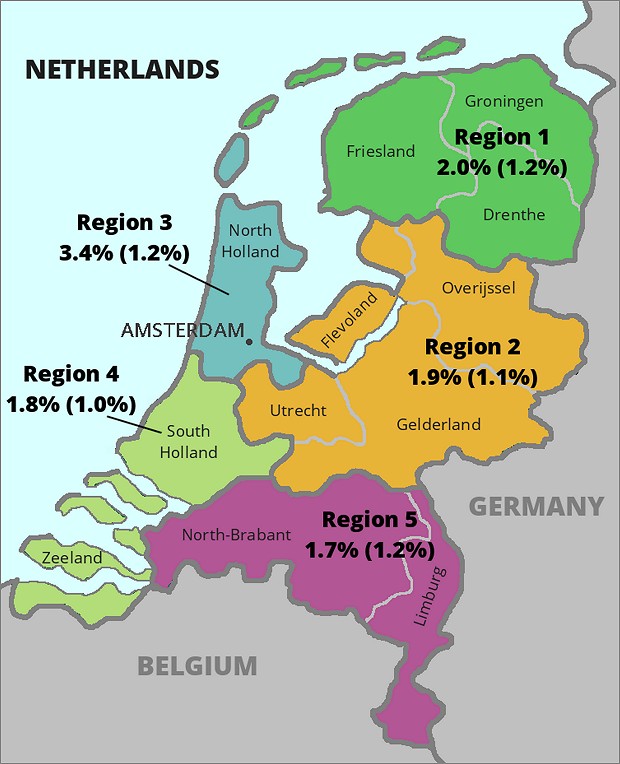 Figure 1: The average assisted death rate (and suicide rate) as a percent of all deaths by region, 2002-14
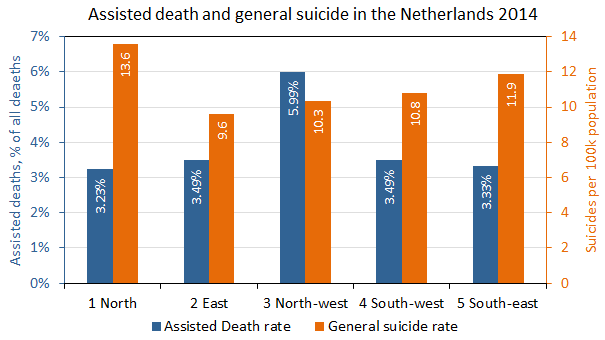 Figure 2: The Dutch assisted death rate and general suicide rate by region for 2014
 “#Catholic church @Pontifex believes all life is sacred&supports #PalliativeCare and use of strong #pain medicines” — Dr Katherine Pettus